Learning Styles and Multiple Intelligences
Learning Styles
Every person learns differently. While we all use multiple ways of learning, most people have one or two dominant learning styles.
Recognizing your child's preferred learning style allows you to personalize their education and build upon their natural strengths.
The Three Primary Learning Styles
- Visual: learns best through observation, pictures, diagrams, charts, demonstrations, and visual materials.
- Auditory: learns best by listening to explanations, discussions, music, and other forms of spoken information.
- Kinesthetic: learns best through movement, hands-on activities, experimentation, and manipulating objects.
Learning Style Assessments
For Elementary School Children
(Completed by parents)
The Learning Style Quiz
For Middle School, High School Students, and Adults
(Self-assessments)
Education Planner – Learning Styles Quiz
The Study Gurus – Learning Styles Quiz
How to Study – Learning Style Assessment
Chegg – What Type of Learner Are You?
Multiple Intelligences Theory
The Theory of Multiple Intelligences, developed by Howard Gardner, suggests that human beings possess different kinds of intelligence, with each individual displaying a unique combination of strengths.
Although everyone develops all of these intelligences to some degree, certain areas are naturally stronger than others. This helps explain why individuals such as Wolfgang Amadeus Mozart, Leonardo da Vinci, Albert Einstein, and Michael Jordan excelled in very different fields.
Understanding your child's strengths and areas for growth can help you create a more personalized and effective educational experience.
The Eight Types of Intelligence
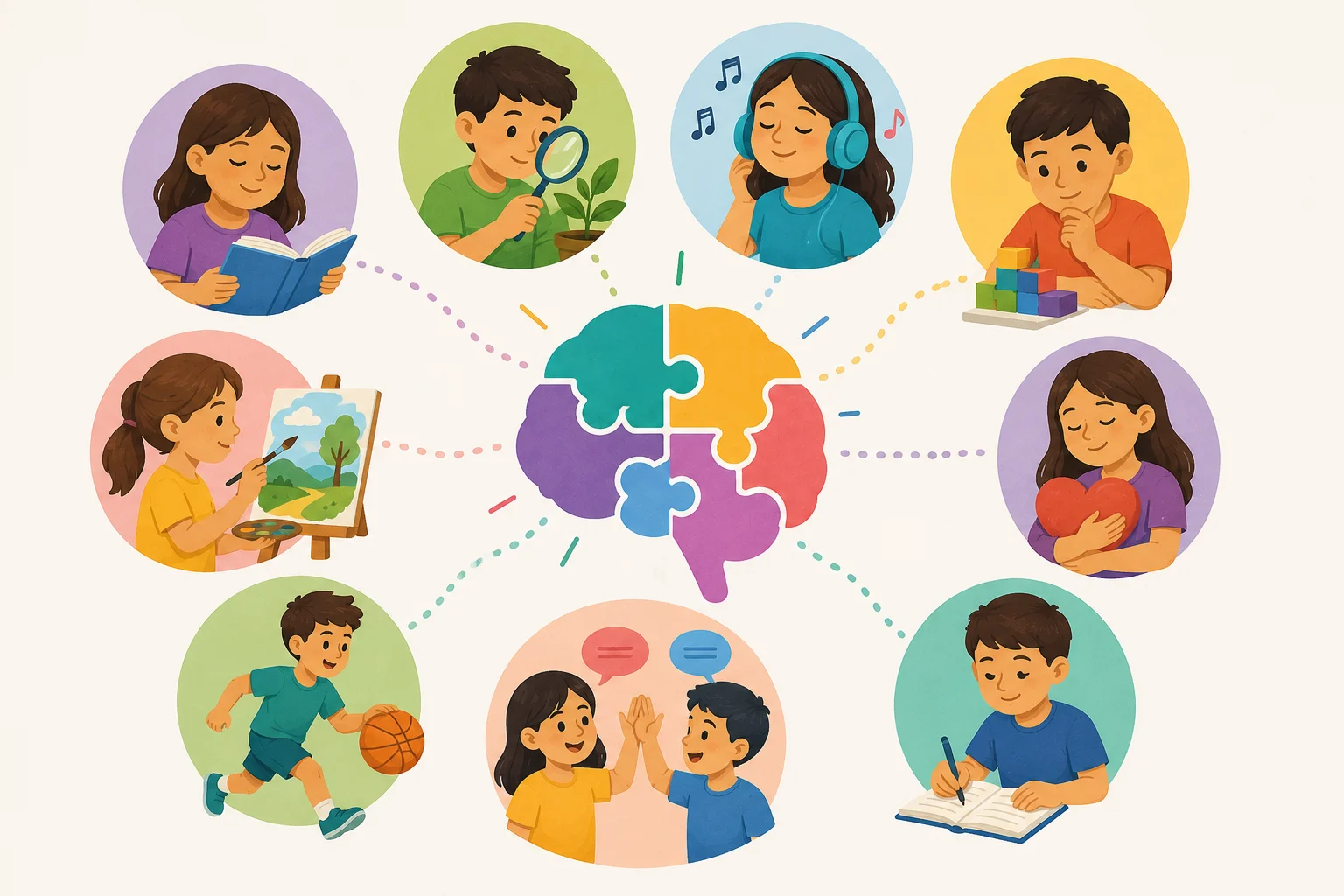
- Linguistic Intelligence - Strength in spoken and written language, reading, writing, and verbal communication.
- Logical-Mathematical Intelligence - Ability in logical reasoning, abstract thinking, problem-solving, and mathematics.
- Visual-Spatial Intelligence - Skill in understanding images, patterns, design, artistic expression, and spatial relationships.
- Musical Intelligence - Sensitivity to rhythm, music, sounds, and musical patterns. Individuals with this intelligence often learn well while listening to music.
- Bodily-Kinesthetic Intelligence - Ability to learn through movement, physical activity, hands-on experiences, athletics, and craftsmanship.
- Interpersonal Intelligence - Strength in understanding and interacting effectively with other people. These individuals typically enjoy collaboration and group learning.
- Intrapersonal Intelligence - Ability to understand oneself, reflect deeply, make independent decisions, and develop self-awareness. These individuals may appear quiet or reserved but often possess strong personal insight.
- Naturalistic Intelligence - Interest in nature, animals, plants, and the environment. People with this intelligence often enjoy outdoor learning and develop a strong appreciation for the natural world.